Food Hunt: Pixel Puzzle
- 4.5
- Rating
- 1.00M
- Installs
- Free
- Price
 Analysis by App-foxy
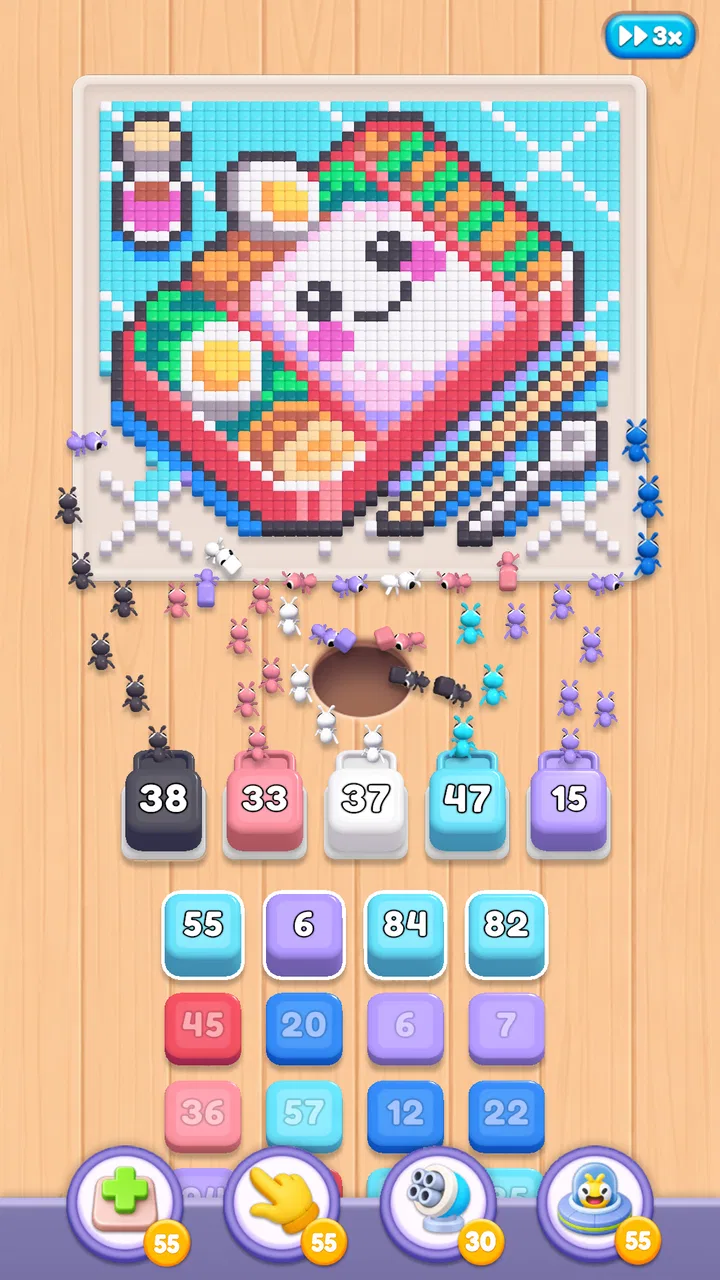
I spent time with Food Hunt: Pixel Puzzle as a casual puzzle game, and its appeal is easy to understand: it turns a simple color-matching idea into a small feeding routine for ants. The presentation is built around the thought that your ants consume food one color at a time, so each move is less about rushing and more about noticing what the board is asking you to do next. I found it approachable within moments, but not completely mindless once the arrangement became less forgiving.
That makes it a good fit for short play sessions. I could imagine opening it while waiting for an appointment, taking a few turns during a break, or playing several rounds at home without needing a long explanation first. It is free to start, rated for Everyone, and developed by EVERFUN. The game’s category is puzzle, but the food-and-ants theme gives it a little more personality than a plain color board.
How the puzzle feels in everyday play
The central idea is deliberately easy to grasp. You are guiding the ants toward food by dealing with one color at a time, and the visual theme helps give each move a purpose. Instead of feeling like an abstract exercise in matching, the board suggests a small task: clear the useful color, make room, and prepare for what follows. That framing is one of the game’s strongest choices because it makes even a quiet puzzle feel active.
You May Also Like

 Blood Strike: 2.5 Anniversary
Blood Strike’s Loadouts Turn Every Drop Into a Tactical Gamble
A close look at Blood Strike’s custom loadouts: how fast access to signature weapons reshapes its battle royale rhythm, rewards preparation, and narrows the gap between fights.

 Pandora - Music & Podcasts
Pandora’s Music Is Easy to Start, but Harder to Recover
Pandora’s strength is its low-effort path from a seed to a station. Its weak spot is how much confidence it asks you to place in connection, setup, and quiet recovery.

 8 Ball Pool
 Is Built on Rivalries, Rematches, and Routine
A close look at the rivalries, rematches, shared routines, and unanswered safety questions that turn a quick pool match into a persistent mobile community.

 Samsung Music
’s Quiet Strength Is Playing What You Already Own
Its reach comes less from spectacle than from dependable access to a personal library. That simplicity is both the app’s strongest retention engine and its ceiling.

 AccuWeather: Weather Radar
AccuWeather Review: A Quick, Clear Forecast for Everyday Decisions
For everyday plans, the best forecast is the one you can understand quickly. AccuWeather makes rain timing, radar, and local conditions easy to act on, with a few trade-offs.

 Hill Climb Racing
Why Hill Climb Racing Still Turns Crashes Into One More Run
A tiny car, a bumpy hill and one more upgrade: Hill Climb Racing keeps resurfacing because its simple chaos makes every near-miss feel personal.
More From Our News Desk
View All News


I would recommend starting with a relaxed approach rather than trying to play quickly. The useful information is often in the order of the colors, not simply in the largest group visible on screen. A move that looks productive immediately may leave the next color awkwardly placed. My practical tip is to scan the whole board before committing, especially when several colors appear close to being useful. That habit helped me avoid treating every obvious match as automatically correct.
The game works best when I treat each level as a compact planning problem. I look for the color that can open the most space, then consider whether that opening actually helps the following move. This is a small but important distinction: clearing something is not always the same as improving the board. Players who enjoy gentle forward planning will probably get more from it than people who want purely instant tapping.
Its simplicity also makes the game suitable for mixed-age households. The Everyone rating reflects that approachable presentation, and the basic concept does not require specialist puzzle knowledge. A child can understand the food objective, while an adult can focus on the order and consequences of each choice. I would still play alongside a younger user if the aim is shared entertainment, since the best lessons come from discussing why one color should be handled before another.
Where the speed feels comfortable
For a casual puzzle, perceived speed matters more than raw intensity. Food Hunt: Pixel Puzzle is the kind of game I would expect to feel comfortable when played in short bursts because its design does not demand constant rapid reactions. You have room to look, decide, and continue. That makes it less stressful than action-oriented mobile games and more suitable for moments when I want something engaging without a high pressure timer dominating the experience.
The slower decision rhythm is also useful on a smaller phone screen. A crowded puzzle can become tiring when every move needs to be made instantly, but the color-based objective gives me a chance to inspect the layout. I found that pausing before a move was part of the strategy rather than a sign that I was playing badly. For anyone who prefers thoughtful puzzles over reflex tests, that is a meaningful advantage.
There is a trade-off, though. Players who want constant novelty or rapid escalation may find the basic loop too restrained. The pleasure comes from arranging the order of actions and watching the board become manageable, not from a dramatic burst of activity. If your usual alternative is a fast match game or an arcade title, this will feel more deliberate and less immediately exciting.
What happens during longer or heavier sessions
Short sessions are the natural match for this concept, but I also tested my own patience by continuing beyond a quick break. The main pressure then comes from repetition rather than from complicated controls. Once I understood the color-first rhythm, I began looking for new ways to make each board efficient. That kept the game interesting for a while, although I would not choose it as my only game for an entire evening.
Longer play also exposes a useful trade-off in puzzle design. The same clarity that makes the opening easy to learn can make the experience feel familiar after repeated rounds. I suggest alternating it with another activity if you are sensitive to repetition. It works especially well as a filler game between more demanding titles, rather than as a replacement for a deep strategy game with a large number of interacting systems.
When I played continuously, my own attention became the limiting factor before the concept did. I started making careless choices because I stopped checking the next color. The best way to avoid that is to divide a board into small decisions: identify the immediate target, check the space it will create, and only then move. That workflow is more reliable than trying to solve the entire board mentally in one glance.
For people wondering whether it suits commuting or intermittent use, I think it does, with one qualification. It is a good choice when you can give the screen a little attention, but not when you need a game that can be played almost automatically. Since the point is to notice color order and board space, distractions can lead to avoidable mistakes. I would use it during a seated wait, not while walking or doing another task.
Stability, recovery, and the practical experience
My overall impression was of a straightforward game that is easy to return to after putting the phone down. Its structure does not require me to remember a complicated control scheme, so recovery after a break is simple: I look at the colors, identify the current objective, and continue thinking from there. That is helpful for a mobile puzzle because interruptions are common.
I also like that the game’s premise gives the board a clear visual anchor. If I return after a few minutes, I am not trying to recall a long story or a chain of special abilities. I can reorient myself by looking at the food and the ants. This is a small design decision, but it improves the feeling of continuity during everyday use.
At the same time, I would not confuse easy recovery with unlimited forgiveness. A careless move can still make the next part of a puzzle less comfortable, so the game rewards attention. My advice is to slow down whenever several colors are nearly available at once. That is where a quick tap can turn a manageable board into one that requires more backtracking or patience.
Because the game is free, it is easy to try without making a commitment first. The commercial model does deserve attention, however. Optional purchases range from $0.99 to $124.99 per item, which is a wide span. I would approach the purchase screen carefully and decide in advance whether I want to spend anything. The free entry point is attractive, but players who prefer a completely purchase-free experience should remain alert to how optional spending fits into their own habits.
Phone requirements and resource expectations
The game supports devices running Android 10 or later, so compatibility is not aimed at very old Android phones. Before installing, I would check the operating system rather than assuming that any Android device can run it. That is particularly important if you are using an older spare phone for casual games.
Beyond that operating-system requirement, I would keep expectations sensible. This is a pixel-styled puzzle rather than a visually elaborate three-dimensional game, so its presentation suggests a lighter workload than graphics-heavy alternatives. I would choose it when I want a game that focuses on board decisions instead of demanding cinematic visuals. That does not guarantee identical performance on every device, but it does explain why the title feels suited to ordinary casual play.
Perceived responsiveness can still depend on the phone, background activity, available storage, and what else is running. I would close unusually demanding apps if the device already feels sluggish, especially before a long session. The game’s puzzle format does not require me to chase maximum frame rates, so a stable, comfortable response is more important than visual spectacle.
Battery expectations should be equally practical. A short puzzle session is a modest use case compared with a large action game, but repeated play, high screen brightness, and other phone activity can still affect endurance. I would lower brightness to a comfortable level and avoid leaving the game open when I am finished. Those are ordinary habits, yet they matter more on an older phone than on a newer one.
Who will enjoy it, and who should choose something else
I think Food Hunt: Pixel Puzzle is best for players who enjoy color organization, light planning, and a friendly theme. It is especially suitable for someone who wants a game that can be learned quickly but still rewards thinking before tapping. Families may appreciate the accessible premise, while experienced puzzle players can use the color order as a small efficiency challenge.
I would be more cautious recommending it to someone who needs deep progression, a story-led campaign, or complex strategic systems. The appeal here is the board in front of you and the satisfaction of handling it cleanly. If you prefer word puzzles, physics puzzles, or long-form strategy, the ant-and-food setup may not offer enough variety on its own. A traditional match game may also be better if you want immediate visual feedback with less planning.
It is also not my first choice for anyone who dislikes in-app purchase prompts in free games. The ability to try it without paying is useful, but the broad purchase range means spending can become a personal boundary worth considering. I would recommend playing the free portion first, deciding whether the basic loop genuinely holds your attention, and only then thinking about any optional purchase.
How it compares with familiar puzzle alternatives
Compared with a standard match-three game, this feels less focused on creating flashy chains and more focused on choosing the correct color at the correct moment. A match-three alternative may be better when I want spectacle, boosters, or a quick sense of accumulation. Food Hunt: Pixel Puzzle is stronger when I want each decision to feel connected to clearing a specific obstacle.
Against minimalist sorting games, the ant theme gives the actions a clearer emotional direction. I am not merely moving colored pieces for the sake of order; I am preparing food for the ants. That does not transform the game into a complex simulation, but it does make the simple objective easier to remember. Players who enjoy a little character in their puzzles may prefer this presentation.
It also differs from word or number puzzles because the challenge is primarily visual. That makes it easier to pick up without reading a lot, but it offers less practice for people who specifically enjoy language or arithmetic. My choice would depend on the moment: Food Hunt for visual planning and a gentle pace, a word game for mental variety, and a deeper strategy title when I have time to manage more systems.
My performance verdict after using it
Food Hunt: Pixel Puzzle succeeds because it keeps its central idea clear. The ants, food, and color order work together, and the result is a puzzle that feels welcoming without being entirely automatic. I appreciated the ability to pause and think, the easy return after interruptions, and the way a simple board can reward a more careful sequence of moves.
The limitations are just as clear. The loop may feel repetitive during extended sessions, it is not aimed at players seeking high-intensity action, and the in-app purchase range is something I would consider before recommending it to a child or to anyone who prefers no-spend games. Device compatibility also begins with Android 10, so owners of older phones should check that requirement first.
The game has an average rating of 4.4 from around 57 thousand ratings and has passed over a million installs, which fits my impression that it has found a broad casual audience. Its current release is version 0.37, and it became available on May 13, 2026. Those details place it as a relatively current free puzzle option rather than an old title I would expect to feel abandoned.
My recommendation is simple: try it if you want a calm, visual puzzle built around planning one color at a time. I would keep it installed for short breaks and low-pressure play, but I would pair it with another game if I wanted more variety or a longer, more demanding challenge. For the right player, the small act of feeding the ants becomes a pleasantly focused routine; for everyone else, the familiar puzzle alternatives may offer more depth or faster excitement.
FAQs for Food Hunt: Pixel Puzzle
01What is Food Hunt: Pixel Puzzle?
Food Hunt: Pixel Puzzle is a casual puzzle game built around colorful pixel-art food themes. Players solve compact picture and tile-based challenges while progressing through different stages and food-inspired settings. The game is aimed at people who enjoy relaxed, easy-to-learn puzzles rather than fast action. Its simple presentation makes it suitable for short sessions, although later levels may require more patience and careful planning.
02How do you play Food Hunt: Pixel Puzzle?
Gameplay generally involves examining a pixel-style puzzle and arranging, matching, or completing its elements according to the objective shown on screen. Each level introduces a small challenge that can usually be understood quickly, while more advanced stages demand better observation and logical thinking. The controls are designed for touchscreens, so most actions can be performed with taps or simple swipes without needing complicated combinations.
03Is Food Hunt: Pixel Puzzle free to download and play?
Food Hunt: Pixel Puzzle may be available as a free download, but players should check the listing for their specific Android or iOS device before installing it. Free games can include optional advertisements, in-app purchases, or extra content that requires payment. The basic experience may be playable without spending money, but some users could encounter ads, boosters, hints, or other optional purchases during progression.
04Does Food Hunt: Pixel Puzzle require an internet connection?
The main puzzle experience may work without a constant internet connection, which makes the game convenient for travel, waiting rooms, or other offline situations. However, certain features can depend on connectivity, including advertisements, purchases, cloud saving, updates, event content, or analytics. It is best to launch the game online at least once and review its behavior before relying on it for completely offline play.
05Is Food Hunt: Pixel Puzzle suitable for children and casual players?
Food Hunt: Pixel Puzzle is generally approachable for casual players because its pixel-art visuals, food-themed presentation, and straightforward touch controls make the basic gameplay easy to understand. Nevertheless, parents should review the app-store age rating and privacy information, particularly if children will play it. Advertising, optional purchases, and increasingly difficult puzzles may also affect whether it is suitable for younger users.
Pros
- Simple pixel-art style makes puzzles easy to read on small screens.
- Short levels fit well into quick breaks or casual play sessions.
- Gradual difficulty increase helps newcomers learn the puzzle mechanics.
- Food-themed visuals give the game a lighthearted
- cheerful atmosphere.
- Offline play is convenient when traveling or using limited mobile data.
Cons
- Repeated puzzle patterns may feel familiar after extended play.
- Small pixel details can be difficult to distinguish on some displays.
- Later stages may require trial and error rather than pure deduction.
- The relaxed pace may not satisfy players seeking fast action.
- Progression can feel slow for users who play several levels at once.

Food Hunt: Pixel Puzzle
Gallery